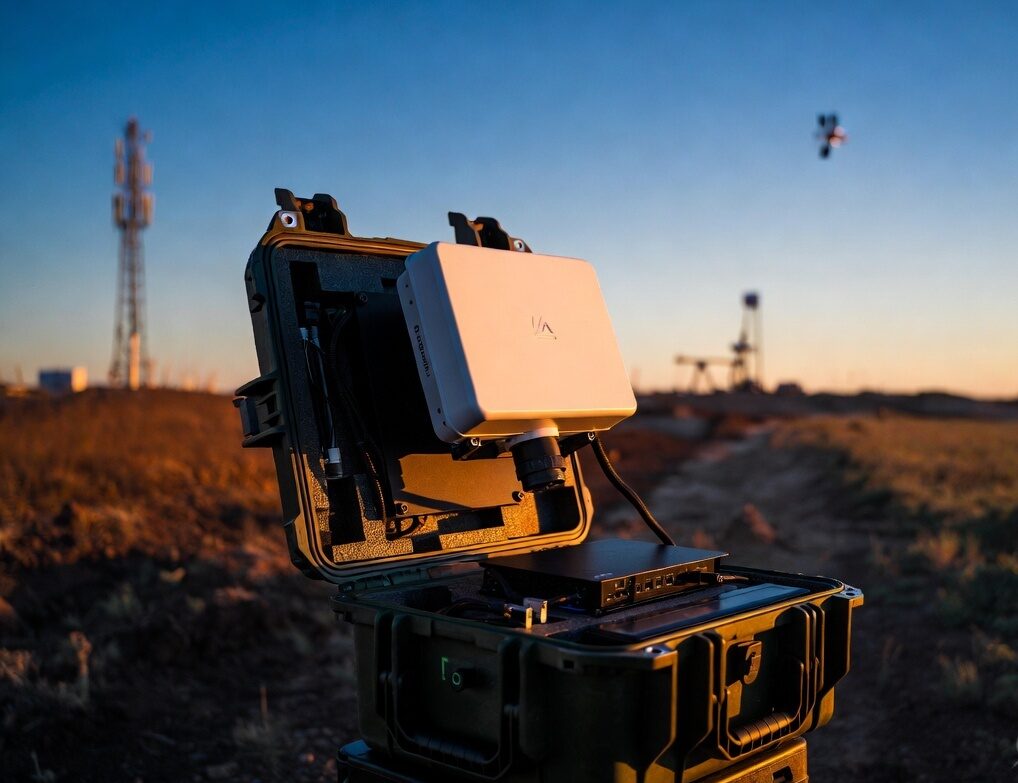

Starlink has changed what’s possible for connectivity in remote locations. But taking a Starlink Mini into the field for industrial operations requires more than the consumer kit and a battery pack. When your application demands reliable connectivity for SCADA systems, real-time monitoring, or coordinated field operations, a consumer setup introduces single points of failure that can take your entire operation offline.
A portable Starlink system built for business combines the Starlink Mini terminal with enterprise-grade routing, cellular failover, managed power, and ruggedized housing. This configuration provides the redundancy and reliability that industrial field operations require, not just internet access, but guaranteed connectivity when it matters.
This guide covers what distinguishes a reliable portable Starlink deployment from a consumer setup, the hardware components involved, and how dual-WAN failover solves the reliability gaps that make satellite-only systems risky for mission-critical applications.
Why Consumer Starlink Setups Fail for Business Use
The standard Starlink kit is designed for residential installation. It assumes stable AC power, a fixed mounting location, and tolerance for occasional outages. None of these assumptions holds in industrial and mobile field deployments.
Single point of failure. Consumer Starlink provides one connectivity path: satellite. When obstructions block the signal, when the constellation is congested, or when the terminal needs to reboot, connectivity drops completely. For residential users streaming video, this is an inconvenience. For field operations running safety systems or coordinating crews, it’s a critical failure.
No enterprise routing. The Starlink router is a consumer-grade device with basic functionality. It lacks VPN support for secure connections to corporate networks, cannot prioritize traffic for critical applications, and provides no visibility into network performance. Industrial operations need traffic management, security policies, and integration with existing network infrastructure.
Power management limitations. Starlink Mini draws approximately 25-40W under normal operation but can spike higher during boot or heavy load. Consumer battery solutions (portable power stations, solar generators) lack the power conditioning, monitoring, and failover capabilities that ensure continuous operation. A battery that reports 50% remaining but cannot sustain the current draw will take your system offline without warning.
Environmental exposure. The Starlink terminal is rated for outdoor use, but the router and power components are not designed for extreme temperatures, vibration, dust, or moisture. Deploying consumer equipment in a vehicle, at a wellsite, or in an incident command scenario exposes its components to conditions they were not designed to withstand.
No redundancy planning. Consumer setups assume Starlink is the only connection. For business use, this creates unacceptable risk. Satellite connectivity has inherent limitations: line-of-sight requirements, latency during satellite handoffs, and potential congestion during peak usage. Without a secondary connection path, these limitations become outages.

What a Reliable Portable Starlink System Requires
Building a portable Starlink system for industrial use requires integrating several components into a unified, field-ready package.
Starlink Mini Terminal
The Starlink Mini is the preferred terminal for portable applications due to its compact size, lower power consumption, and integrated mounting flexibility. It offers peak download speeds up to 220 Mbps according to Starlink specifications. In real-world testing, it consistently delivers around 150 Mbps download (90th percentile) and 15 Mbps upload. The terminal operates at approximately 25-40W average power and connects via Ethernet when paired with the appropriate adapter, allowing seamless integration with enterprise routers.
For portable deployments, the Mini mounts in the lid of a ruggedized case, providing a clear view of the sky when deployed while protecting the terminal during transport.
Enterprise Router with Dual-WAN Capability
The router is the critical component that transforms a Starlink connection into a reliable business system. Consumer routers cannot provide the failover, security, and management capabilities that field operations require.
Enterprise cellular routers from Ericsson (formerly Cradlepoint) and Peplink provide:
- Dual-WAN failover: Automatic switching between satellite and cellular when the primary connection fails or degrades
- SD-WAN traffic management: Prioritize critical applications, route traffic based on policies, and bond multiple connections for increased throughput
- VPN connectivity: Secure tunnels to corporate networks, compatible with enterprise security infrastructure
- Remote management: Cloud-based monitoring, configuration, and troubleshooting through NetCloud (Ericsson ) or InControl (Peplink)
- Cellular connectivity: Integrated 5G/LTE modems that provide the secondary WAN connection for failover
The router choice depends on performance requirements. Single-modem routers like the Ericsson R980 or Peplink MAX-BR1-PRO-5G provide satellite plus cellular failover. Dual-modem routers like the Ericsson Cradlepoint R1900 or Peplink MAX-BR2-PRO-5G add carrier redundancy, allowing failover between cellular providers in addition to satellite.
Managed Power System
Portable operation requires proper battery management. Industrial portable Starlink systems use LiFePO4 batteries for their stability, longevity, and safety characteristics. These batteries are paired with:
- Battery management system (BMS): Monitors cell health, prevents over-discharge, and manages charging
- Power conditioning: Clean, stable output that protects sensitive electronics
- Runtime monitoring: Accurate state-of-charge reporting so operators know the actual remaining runtime
- Multiple charge inputs: AC, DC (vehicle), and solar compatibility for field recharging
A properly sized system provides 20+ hours of continuous operation, sufficient for a full deployment day with margin for extended operations.
Ruggedized Enclosure
All components mount in a ruggedized case that protects against the environmental conditions found in field deployments. Indestructible, lightweight plastic carrying cases with IP67 ratings (dust-tight, submersible to 1 meter) provide the necessary protection. The case design integrates:
- Starlink Mini mount in lid: Deploys when the case is opened, stows protected during transport
- Internal component mounting: Router, battery, and power management secured against vibration
- Internal antenna: Integrated cellular, WiFi, and GPS antennas with high gain for additional range
- Ventilation and thermal management: Active fan cooling that maintains operating temperatures without exposing internals to contamination
- Transport handles and tie-down points: Secure transport in vehicles, aircraft, or by hand
Dual-WAN Failover: Why It Matters for Field Operations
The defining feature that separates business-grade portable Starlink systems from consumer setups is dual-WAN failover. This capability uses both satellite and cellular connections, automatically switching between them based on availability and performance.
Satellite and cellular have complementary strengths and weaknesses. Ericsson’s documentation on Starlink and 5G integration describes this as “wireless-optimized SD-WAN,” where each connection type handles what it does best.
Starlink strengths: Available nearly anywhere with sky visibility, independent of ground infrastructure, and consistent coverage in remote areas where cellular doesn’t reach.
Starlink limitations: Requires a clear line of sight (trees, terrain, structures cause dropouts), higher latency than cellular (typically 25-60ms vs. 10-30ms for LTE/5G), and potential congestion in heavily subscribed areas.
Cellular strengths: Lower latency, higher coverage reliability, works under canopy and inside structures, inherently more secure than satellite.
Cellular limitations: Coverage gaps in remote areas, tower damage during disasters, and capacity limitations during high-demand events.
With dual-WAN failover, the system continuously monitors both connections. When Starlink drops due to an obstruction or the terminal reboots, cellular service automatically takes over. When cellular coverage is unavailable (e.g., entering a remote area or during a tower outage), the satellite handles traffic. The transition happens immediately, often without interrupting active sessions.
For advanced deployments, SD-WAN capabilities enable simultaneous connection bonding, combining bandwidth and providing packet-level redundancy for critical applications.
Use Case: Remote Site Operations
Oil and gas wellsites, utility substations, mining operations, and similar remote facilities increasingly require connectivity for operational technology (OT) systems that cannot tolerate outages.
The operational challenge: A wellsite 50 miles from the nearest town has marginal cellular coverage (one or two LTE bars that drop entirely during bad weather) and no wired infrastructure. The site runs SCADA systems monitoring pressure, flow rates, and safety equipment. Production data uploads continuously. Video surveillance monitors for security and safety compliance. Field technicians need connectivity for work orders, documentation, and communication.
Previously, the operation relied on a VSAT terminal with high latency, limited bandwidth, and expensive per-MB data costs. Cellular boosters improved coverage marginally but couldn’t solve fundamental coverage gaps.
The portable Starlink solution: A dual-WAN system pairs Starlink Mini with an Ericsson Cradlepoint router. Starlink provides primary connectivity with dramatically improved bandwidth (100+ Mbps vs. 5-10 Mbps on the previous VSAT) and lower latency. The integrated cellular modem provides failover during Starlink outages.
The system deploys in a ruggedized case that can relocate as operations move between wellsites. When a new site is established, connectivity is operational within minutes of case deployment, no waiting for VSAT installation or line-of-sight surveys.
Operational outcomes:
- SCADA data transmission maintains real-time visibility into site operations
- Video surveillance supports remote monitoring, reducing required site visits
- Field technicians access cloud-based systems for work orders and documentation
- Failover ensures connectivity during brief Starlink outages caused by terminal handoffs or temporary obstructions.
- Per-site connectivity costs decrease compared to legacy VSAT with metered data.
Use Case: Mobile Command and Incident Response
Utilities, government agencies, and emergency management organizations deploy mobile command posts when responding to incidents where local infrastructure is damaged or unavailable.
The operational challenge: A regional utility maintains incident response capabilities for storm damage, wildfire coordination, and infrastructure emergencies. When deployed, command staff need connectivity for coordination systems, GIS mapping, weather data, crew dispatch, and communication with operations centers. The deployment location is unpredictable, and local cellular and wired infrastructure may be damaged or overloaded by the event.
Previous mobile command relied on cellular with satellite backup through a trailer-mounted VSAT. The VSAT required setup time, a trained operator, and generator power. Cellular-only deployments failed when responding to events that damaged towers or overwhelmed network capacity.
The portable Starlink solution: Multiple portable Starlink cases deploy with response teams. Each case provides independent connectivity that operates within minutes of arrival. Starlink functions independently of ground infrastructure damage. Cellular provides backup and handles traffic when the satellite is temporarily obstructed by terrain or structures at the deployment location.
The portable Starlink cases run on an internal battery for initial deployment, then connect to vehicle or generator power for extended operations. Cases relocate with the command staff as the incident evolves, maintaining connectivity through movement.
Operational outcomes:
- Connectivity operational within minutes of arrival, no setup crew required
- Satellite connectivity is independent of local infrastructure damage
- Multiple cases provide redundant connectivity paths (if one case fails, others maintain operations)
- Battery operation enables deployment before generator or vehicle power is established
- The portable format allows redeployment as the incident command relocates
Use Case: Construction and Infrastructure Projects
Construction sites, pipeline projects, and infrastructure development create temporary work locations that require connectivity for BIM (Building Information Modeling) coordination, equipment telematics, drone operations, and administrative functions.
Large projects may operate for months or years, but the site office location shifts as work progresses. Traditional solutions (temporary fiber, fixed wireless) require installation time and cannot be relocated. Cellular-only solutions fail in the remote corridors where pipelines, transmission lines, and highways are built.
Portable Starlink systems are deployed with the project office and relocated as needed. Dual-WAN provides reliable connectivity across varying cellular coverage conditions encountered along a linear project route. The ruggedized format withstands job-site conditions that destroy consumer equipment.
How to Evaluate Portable Starlink Solutions
When selecting a portable Starlink system for industrial applications, evaluate these factors:
Router capability: Does the integrated router support your security requirements (VPN types, firewall policies)? Does it provide the management visibility your IT organization requires? Single-modem or dual-modem, depending on cellular redundancy needs?
Power system: What is the realistic runtime on battery? How does the system monitor and report remaining capacity? Which charge input options are available for your deployment scenarios?
Environmental ratings: What IP rating does the enclosure carry? What temperature range is supported? Has the system been tested for vibration and shock?
Antenna performance: For cellular failover, what external antenna options exist? MIMO antenna support for maximum cellular performance?
Integration and support: Is the system assembled, configured, and tested before delivery? What support is available for deployment and troubleshooting?
Build Reliable Portable Connectivity for Your Field Operations
Consumer Starlink provides internet access. Industrial operations require reliable connectivity with redundancy, security, and management capabilities that consumer equipment cannot deliver.
A properly configured portable Starlink system combines satellite and cellular in a dual-WAN architecture, managed by enterprise routing, powered by a monitored battery system, and protected by ruggedized housing. This configuration transforms Starlink from a consumer product into a field-ready infrastructure component.
To discuss portable Starlink solutions for your specific operational requirements, contact Westward Sales for a consultation.
Additional Resources
Related services: Starlink Mobile Hotspot Devices | Cellular Routers | Mobile Hotspots | View All Products
Related products: Starlink Mini Portable Case with Ericsson R1900 | Starlink Mini Portable Case with Ericsson R980 | Starlink Mini Portable Case with Peplink MAX-BR1-PRO | Starlink Mini Portable Case with Peplink MAX-BR2-PRO | Starlink Mini Mobile Case with Ericsson R1900 + MC400
Disclaimer: This content is provided for informational purposes only and does not constitute professional engineering advice. System selection for critical applications should involve consultation with qualified engineers familiar with your specific operational and safety requirements. Starlink service availability and performance depend on SpaceX’s network deployment and service plans.

Leave a Reply